
The persistent Cartesian error...
Hopefully the Enlightenment will come to be seen as a failed project, like the Beatles' White Album.

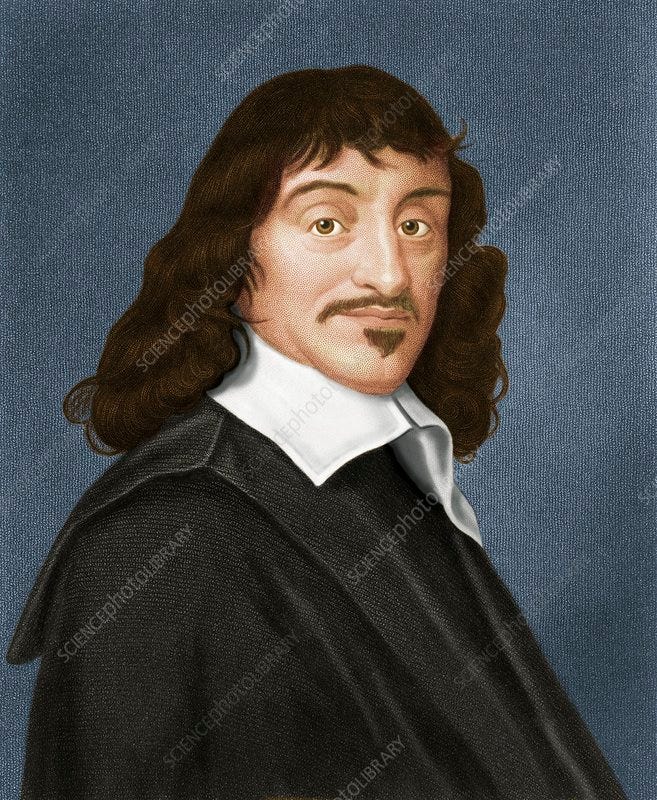
Renee Descartes, 1596-1650.
The Cartesian picture of the human person takes him to be a conjunction of two substances, one of which is soul or mind (res cogitans), the other physical body (res extensa). We are thinking selves, capable also of conceiving ourselves as such. We also happen to be embodied and those bodies are subject to the causal laws applicable to all physical or material objects.
What is the nature of this conjunction, how does it (as I just said) “happen to be” that these two substances find themselves in this mysterious, metaphysical marriage of convenience?
Descartes insists that the mind (soul) and the body are, as the philosophers put it, logically and ontologically independent of each other. So the familiar objection suggests itself: in that case, how is it they causally interact?
I feel a toothache coming on so I reach for the Jack Daniels; I remember a romance that was not in the end meant to be, this causes me to wipe a tear from my eye; I notice that Adolescence has invaded my TV screen so I spit out the JD, grab the remote, and change the channel (to anything else).
The Cartesian picture has a problem with these quite quotidian and very natural psychophysical transactions. That difficulty is routinely under-emphasised. I would put it as follows: the mind-body relationship goes beyond “interaction” , and seems to be more a type of intimacy.
Gilbert Ryle, in The Concept of Mind, argues that Descartes’ mistake is to bracket off the mind and to talk about it as if it were some sort of ghost contingently inhabiting the machinery of the human body. This, he suggests, is a category error, from which many confusions will follow. And dangers too, in that the Cartesian argument seems at least preparatory to a commitment to something like solipsism (the philosopher’s term for catatonia).
Ryle is right in saying Descartes is wrong, but wrong about how he is wrong. The Cartesian error is not the ghostly privatisation of the mind. His more fundamental mistake is his conception of causation as it applies to physical bodies. This misconception has been an intellectual and moral catastrophe, a motivating assumption of the failed Enlightenment experiment.
(A word on that. It would be nice to think that the Enlightenment, viewed sub specie aeternitatis, is an historical aberration. A bit like the Beatles’ White Album perhaps, where one or two good tracks (While My Guitar Gently Weeps) are scattered within the dreck. When you take the Enlightenment, examine the sleeve notes, play it backwards as well as forwards, you discover that -despite the hype- there isn’t really much there of lasting merit. Hopefully the Western intellectual tradition will self-correct and come up with its own Let It Be.)
The error I refer to is the view of causation as mechanism. Descartes, an Enlightenment draughtsman at the very least, and architect also of the Scientific Revolution1 was happy to endorse a scientific methodology which had no use for the Aristotelian-Thomistic concept of final cause. Final cause metaphysics sees the universe as rinsed in purpose, as the implementation of a continuous process of turning the potential into the actual ordered to a teleological principle which is a thought in the mind of God.
Thus in Christian natural theology, causal interactions are not relationships of power but are rather expressions of God’s non-competitive interaction with the world as he creates and recreates it (and us) from moment to moment. Causation is not mechanism but the empirical working through of His love.
Enlightenment thinkers, in the main, have made scientific explanations less complete by replacing (or ignoring) teleology with mechanism. When Descartes proposed an uncompromising dualistic ontology it was the operations of matter, not the character of mind, that became unnecessarily problematic or difficult to explain.
This is why a thinker like David Hume was quite right to conclude that within the parameters of Enlightenment empiricism all you can say about causation is that it amounts to “succession and constant conjunction”, that it is more a habit of thought than a structural property of the world “in itself”. Because the “parameters of Enlightenment empiricism” have an unenlightened idea of what it means for one thing to cause another.
If you insist on a transactional account of causation then there is nothing especially jarring about the Cartesian division between body and mind, and least not when it comes to the question of how they interact.
This, then, is the persistent Cartesian error: to think of causation as mechanism rather than intimacy. And to fail to hear that God is whispering to us every time we wipe away that tear or reach for the remote.
Which, like all revolutions, thrived on confected antagonism, in this case by starting an unnecessary conflict between reason and religious faith.
Dear Sean, I struggled to follow your reasoning but the final line spoke clearly. Thankyou. PS I’m sure your piece was brilliantly argued, there were just to many unkent words for my befuddled brain. Cheers, Andy